When the air inside your home feels stale, unusually damp, or dusty again soon after cleaning, it is reasonable to wonder whether something needs attention. In Loxahatchee and across Palm Beach County, air conditioning runs through much of the year, while outdoor humidity can make moisture control a regular part of home comfort. Still, a smell or a dusty room does not identify one specific cause. These seven signs can help you decide what to observe, what to check, and when to ask for a professional assessment.
In this article
1. Indoor humidity that stays high
Humidity is part of the indoor-air picture, especially in a warm, humid climate. If the home feels clammy, towels take unusually long to dry, or a humidity gauge repeatedly reads high, make a note of when and where it happens. A small hygrometer from a hardware store can help you track conditions over several days. EPA guidance says indoor relative humidity should stay below 60 percent, ideally between 30 and 50 percent. A reading is useful context, not a diagnosis of the equipment.
Take readings in more than one room and at different times, rather than relying on one moment near a bathroom or kitchen. That can help distinguish a temporary increase after a shower from a home-wide pattern. Keep the gauge away from direct sunlight, supply air, and appliances that release heat or moisture, since those can affect what it reads.
Check whether bathroom and kitchen exhaust fans are being used when bathing or cooking, and look for obvious plumbing or roof leaks. Do not assume that opening windows will help in humid weather. Warm outdoor air can add moisture to a cooled home. If humidity remains high while the AC runs, a technician can inspect system operation, condensate drainage, and whether the equipment is cooling and dehumidifying as intended. For broader context, see the EPA's home indoor-air-quality recommendations.
2. Odors that keep returning
A persistent musty, smoky, chemical, or cooking odor deserves attention, but smell alone cannot tell you what is in the air or where it started. First consider the source: a damp cabinet, a drain, stored chemicals, a recently used cleaning product, cooking residue, or a trash area may be responsible. Check whether the odor appears in one room, near a specific vent, or throughout the house, and whether it follows a particular activity.
Try noting whether the odor comes and goes with the AC cycle, but remember that timing is only a clue. Air can move through a home and make the source harder to pinpoint. If you suspect a fuel leak, burning electrical smell, or another immediate hazard, leave the area and contact the appropriate emergency service.
Address a clear source safely and follow product labels. Avoid covering a persistent odor with fragrance, which can add another product to the indoor environment without addressing the original cause. If a musty smell returns after you have removed obvious sources, look for signs of moisture and arrange the appropriate building or HVAC inspection. The system may be one part of the investigation, but it is not automatically the source.
3. Dust that builds up quickly
Some household dust is normal. It comes from many sources, including outdoor particles, fabrics, people, pets, and everyday activity. But if dust seems to return quickly in several rooms, especially alongside weak airflow or a filter that becomes dirty sooner than expected, it may be worth checking the basics.
Notice where it collects. Dust concentrated near one supply grille may call for a different investigation than dust spread throughout the home. Recent remodeling, sanding, or nearby outdoor work can also change what enters the house for a while. A useful inspection starts with that context instead of assuming every dust concern comes from ductwork.
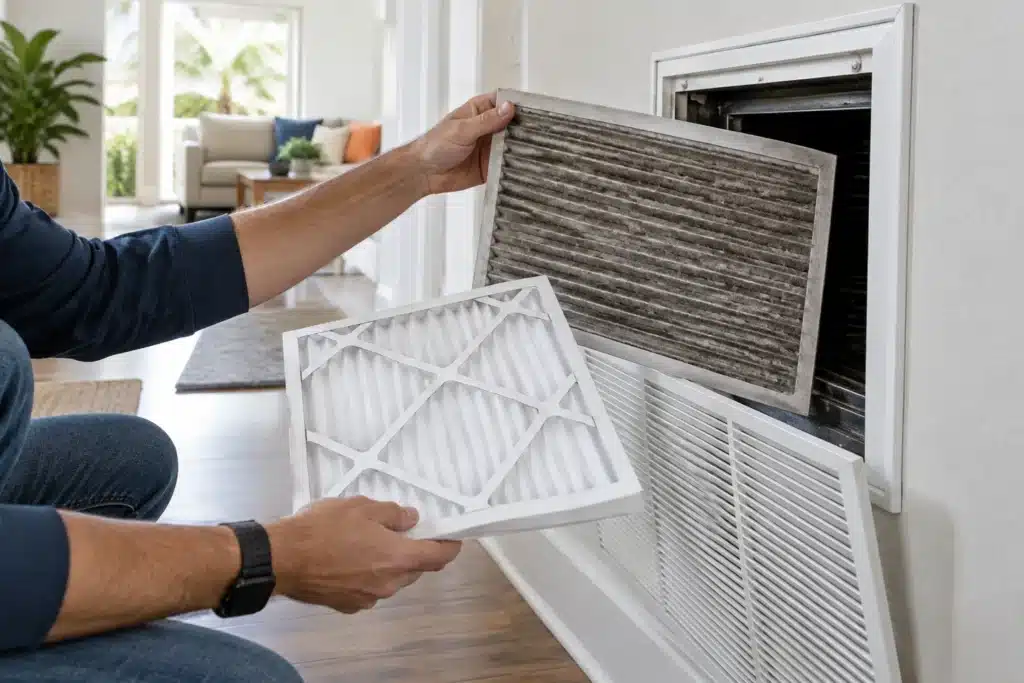
Make sure the air filter is installed in the correct direction and fits its slot without gaps or bending. Confirm the size and replacement schedule shown by the equipment or filter manufacturer. Also note whether construction, a recent renovation, pets, or open windows could be contributing. Dust by itself does not prove that ducts need cleaning or replacement. If the pattern continues, an HVAC professional can check the filter setup, airflow, and accessible system components. Tri-County's ductwork replacement service is relevant when an inspection identifies a duct issue that calls for that work.
4. An HVAC filter that loads up fast
A visibly dirty filter is a useful maintenance signal, but there is no single replacement interval that fits every home. Pets, occupancy, construction dust, filter type, and system runtime all affect how quickly a filter collects particles. Follow the manufacturer's instructions, inspect the filter regularly, and record how long it takes to look dirty in your household.
Use a phone reminder or mark the replacement date on a calendar so you can compare intervals over time. If the filter is repeatedly collapsing, becoming wet, or pulling away from its frame, stop and ask for help identifying why. Do not run the system without a filter unless the equipment instructions specifically direct you to do so.
Choose a filter that fits the equipment. A higher-efficiency filter is not automatically the right choice for every system; a restrictive filter can affect airflow if the equipment was not designed for it. Ask a technician which filter ratings your system can accommodate before upgrading. EPA explains that filtration can reduce some airborne particles, while source control and ventilation also matter. HVAC filters do not remove every pollutant. Learn more about EPA guidance on home air cleaners and filters, and see Tri-County's preventative AC maintenance information for system-care support.
5. Condensation or moisture near the AC
Water around an indoor air handler, a damp ceiling near ductwork, or recurring condensation at a supply register is worth documenting. Note whether it appears during AC operation, after heavy rain, or after plumbing use. Take a photo if doing so is safe, and check for an obvious nearby plumbing or roof source. These clues can have several explanations; they do not identify a failed part on their own.
Dry-looking surfaces do not always rule out a hidden leak, and a brief patch of condensation does not by itself establish a larger problem. If you see water staining, swelling, or repeated dampness, note the location and how it changes. A roofer, plumber, building professional, or HVAC technician may be the right contact depending on the source.
Do not open electrical panels or take apart HVAC equipment. If water is actively leaking near electrical components, keep clear and contact a qualified professional. For recurring moisture, schedule an inspection so the source can be identified. Addressing moisture promptly matters because persistently wet building materials can create conditions for mold growth. EPA's guide to mold, moisture, and the home explains why finding and correcting the moisture source is important.
6. Rooms that feel stuffy or uncomfortable
A room that feels stale, warm, or poorly circulated can point to several different things: a closed or obstructed supply register, a dirty filter, duct leakage, an airflow imbalance, insulation or sun exposure, or ventilation that does not suit the home. The room's comfort alone will not tell you which one applies.
Make a simple room-by-room note: which spaces feel different, when the problem is most noticeable, whether doors are usually open or closed, and whether airflow from each register seems weak. Check that supply and return grilles are not blocked by furniture or curtains. Avoid making repeated thermostat changes to force a result. If the pattern persists, a technician can evaluate airflow and system operation. Tri-County provides indoor air quality solutions and can help determine whether the concern calls for an HVAC adjustment, ductwork attention, or another next step.
7. Recurring irritation indoors
Some people notice eye, nose, or throat irritation, headaches, or discomfort in a particular indoor setting. Those experiences can have many causes, including non-indoor-air factors. They are not a reliable way to identify a pollutant or confirm an HVAC problem. Keep a simple record of when the discomfort occurs, which rooms are involved, and whether it lines up with cooking, cleaning, renovations, or time outdoors.
If you have health concerns, speak with a healthcare professional. For an indoor concern, reduce or remove obvious pollution sources where practical, use kitchen and bathroom exhaust fans that vent outdoors, and check for moisture. When the pattern appears connected to the AC or airflow, a qualified HVAC technician can inspect the system. EPA describes source control, ventilation, and filtration as complementary approaches; no single filter or device addresses every indoor-air concern.
What to do next when indoor air quality concerns persist
Start with observations rather than guesses. Write down the rooms and times involved, indoor humidity readings, filter condition and replacement date, any visible moisture, and what was happening when odors or discomfort appeared. Check the filter and make sure grilles are clear, but leave electrical, refrigerant, and internal equipment work to a professional.
Keep the notes for a few days if the issue is intermittent. A short record can make a service conversation more productive and reduce the temptation to replace equipment or add a product before the source is understood. If you rent, report building leaks or indoor-air concerns to the property owner or manager as well.
A useful evaluation should connect the reported concern to observable conditions and explain what was checked. Depending on the home, that may include filter fit, airflow, condensate drainage, visible duct conditions, or system operation. Indoor air quality is broader than air conditioning, so a building leak, plumbing issue, source product, or ventilation condition may need a different professional to address it.
Tri-County HVAC serves Loxahatchee and communities across Palm Beach County. If your concern may involve AC operation, moisture around the system, or airflow, call (561) 281-8074 or contact Tri-County HVAC to discuss scheduling a service visit. You can also schedule online. A technician can inspect the HVAC-related parts of the concern and explain appropriate next steps.
Frequently asked questions about indoor air quality
Can my air conditioner improve indoor air quality?
An HVAC filter can capture some airborne particles as air passes through it, and system maintenance can help the equipment operate as intended. Filtration is only one part of indoor air quality. Source control, moisture management, and suitable ventilation may also matter, depending on what is causing the concern.
How humid should a home be in South Florida?
EPA guidance recommends keeping indoor relative humidity below 60 percent, ideally between 30 and 50 percent. Use a hygrometer to understand the conditions in your home over time. If readings stay high despite normal AC operation, ask an HVAC professional to check the system and drainage. A persistent moisture source may need attention outside the HVAC system.
Should I install a higher-rated filter?
Not without checking that it fits and that the HVAC system can handle its resistance to airflow. Use the filter type and size recommended by the equipment manufacturer, or ask a technician to confirm a compatible option. A more restrictive filter is not automatically an improvement for every system.
Does a musty odor mean there is mold in my AC?
No. Odor alone cannot confirm mold or identify its location. Look for moisture or water damage and have the source investigated. An HVAC inspection can assess system-related conditions, while building or plumbing issues may require another qualified professional.
When should I call an HVAC technician?
Schedule an inspection if humidity remains high, moisture appears near the equipment, airflow is weak, a filter becomes dirty unusually quickly, or an odor seems tied to system operation and keeps returning. If water is near electrical parts, stay clear and seek professional help.